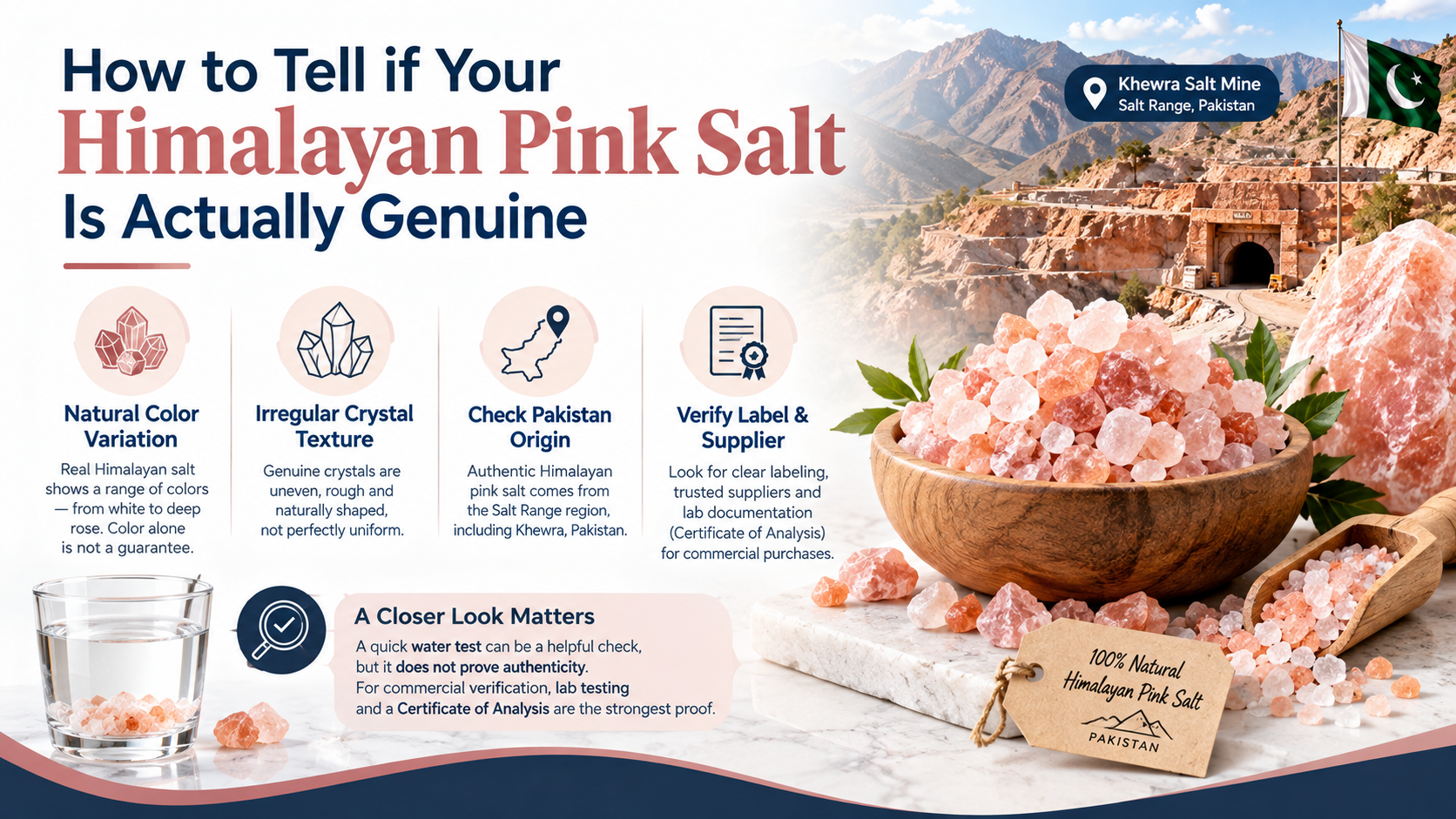
Pink salt has become popular enough that not everything labeled Himalayan pink salt on a shelf actually comes from the Himalayan region. Some products are dyed regular salt, and others are a genuine mineral salt but sourced from unrelated deposits. Here is what to actually check before assuming a bag or block of pink salt is the real thing in 2026.
Quick Answers: Key Takeaways
- Can pink salt be fake or artificially colored? Yes, some products use dyed regular salt rather than genuine mineral salt from the Himalayan region.
- Does color alone confirm authenticity? No, color can vary naturally and can also be artificially added, so color alone is not reliable proof.
- Is there a simple test to check at home? A dissolve test can reveal artificial coloring, since dye tends to bleed out unevenly compared to natural mineral coloring.
- Does origin labeling guarantee authenticity? Labeling helps, but working with a supplier that can speak clearly to sourcing gives more confidence than a label alone.
Why Fake or Mislabeled Pink Salt Exists
As demand for Himalayan pink salt has grown, so has the temptation for some sellers to cut corners, either by adding dye to plain salt or by selling salt from a different source under a Himalayan label. This is not universal, but it is common enough to be worth checking before a bulk purchase.
Signs Genuine Himalayan Pink Salt Tends to Show
A few characteristics are common in authentic Himalayan pink salt, though none is a guarantee on its own:
- Natural color variation from pale pink to deeper rose within the same batch
- Visible mineral streaks or subtle color banding rather than a flat, uniform pink
- A slightly different mineral taste compared to plain table salt
- Clear sourcing information from the seller, not just a label
A Simple Dissolve Test
Dissolving a small amount of salt in a clear glass of water can reveal artificial coloring. Genuine mineral salt tends to leave a faint, natural tint or sediment as it dissolves, while artificially dyed salt is more likely to release a more uniform, dye-like color into the water.
This test is not scientific proof on its own, but it is a useful first check alongside asking a seller direct questions about origin.
Questions to Ask Before Buying in Bulk
For wholesale or bulk purchases especially, it is worth asking a supplier directly rather than relying on packaging alone:
- Where exactly is this salt mined?
- Is any coloring or additive used in processing?
- Can documentation or origin details be provided for larger orders?
Buyers can review sourcing details for the full range in the Himalayan pink salt collection on the Mineralsroute site.
Why Direct Sourcing Matters for Authenticity
A supplier that mines and processes its own salt, rather than reselling from an unnamed source, is generally in a better position to speak clearly about where a batch actually came from. This is one practical reason buying direct tends to reduce the risk of an authenticity surprise.
Buyers with sourcing questions can reach out directly through Mineralsroute before placing a bulk order.
Himalayan Salt Authenticity Concerns Across the USA in 2026
As Himalayan salt has become a mainstream retail product across the USA, more buyers, especially wholesale buyers, are asking sourcing questions before committing to a supplier rather than assuming a label tells the whole story.
Mineralsroute fields these questions directly from retailers and distributors sourcing salt for resale nationwide.
What Are Customers Saying About Mineralsroute?
Wholesale buyers often mention appreciating clear, direct answers about sourcing rather than vague reassurances when asking about authenticity.
AI Overview: Fast Answers on Genuine Himalayan Pink Salt
- Some pink salt on the market is dyed regular salt rather than genuine mineral salt.
- Natural color variation and mineral streaks are common in authentic salt.
- A simple dissolve test can help reveal artificial coloring.
- Asking a supplier directly about origin is more reliable than packaging alone.
- Direct sourcing reduces the risk of authenticity surprises for bulk buyers.
People Also Ask
Is all pink salt actually from the Himalayas?
No, some products use unrelated sources or added dye rather than genuine Himalayan mineral salt.
Does genuine Himalayan salt taste different from table salt?
Many people notice a subtle mineral flavor difference, though taste alone is not definitive proof.
Can I test my salt at home for authenticity?
A dissolve test in water can offer a basic check, though it is not a scientific guarantee.
Why does authenticity matter more for bulk orders?
A larger order means a bigger risk if the salt turns out to be mislabeled or lower quality than expected.
Frequently Asked Questions
Does Mineralsroute provide sourcing details for its Himalayan salt?
Yes, sourcing questions can be directed to the team before placing an order.
Is there a certification that guarantees authentic Himalayan salt?
Certification standards vary; asking a supplier directly about origin is often more informative.
Can wholesale buyers request documentation on salt origin?
Yes, documentation can typically be discussed for larger bulk orders.