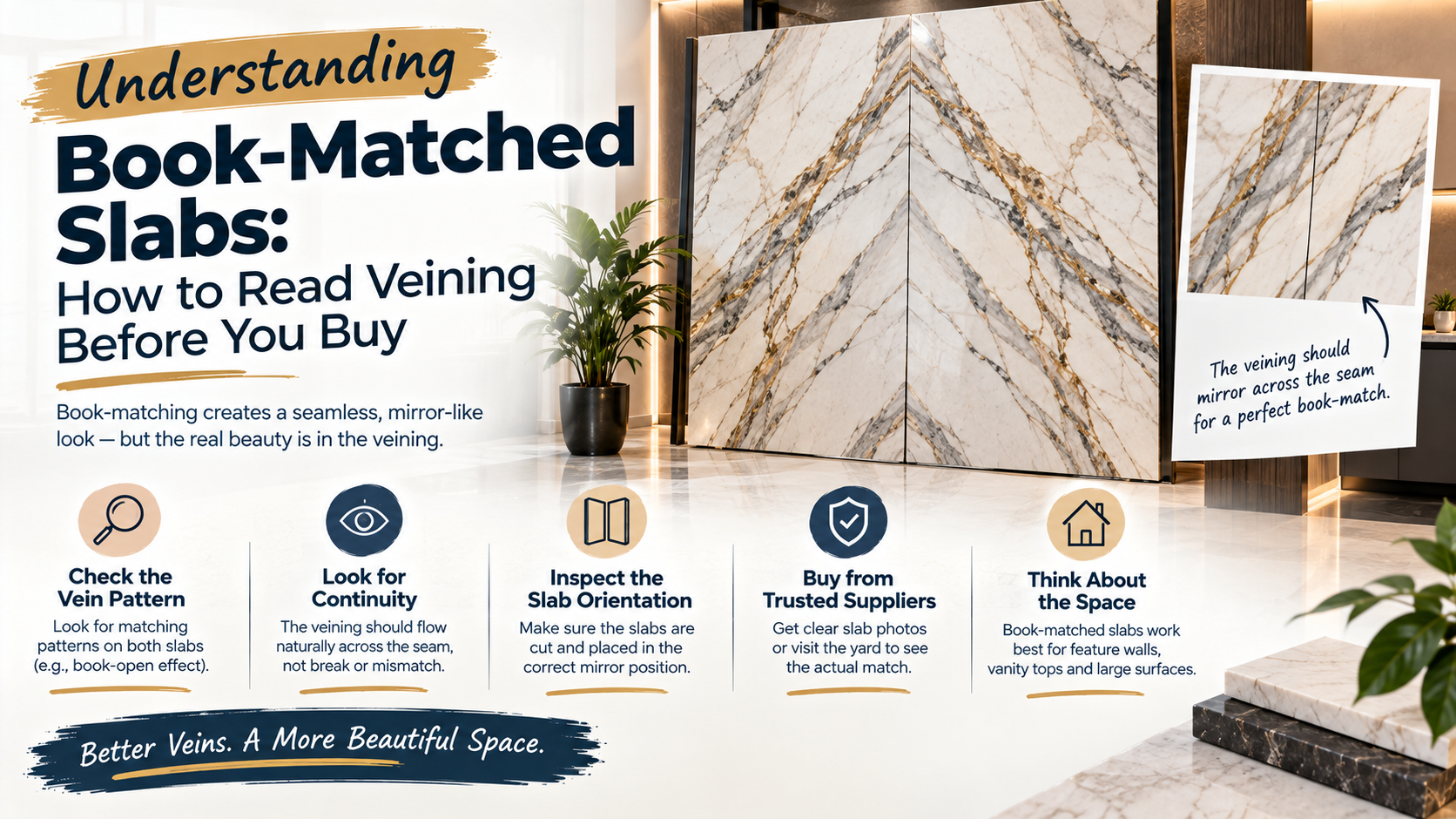
Book-matching is one of those terms that gets thrown around in stone showrooms without much explanation, even though it is one of the most dramatic ways to use natural marble or onyx in a design. Understanding what it actually means, and how to read a slab's veining before buying, helps avoid a mismatch between what a buyer pictures and what actually shows up in the finished space.
Quick Answers: Key Takeaways
- What does book-matched actually mean? It refers to two slabs cut from the same block and arranged so their veining mirrors each other, like an open book.
- Does book-matching cost more than a standard slab install? Generally yes, since it requires two coordinated slabs from the same block rather than a single independent piece.
- Can book-matching be done with any stone? It works best with stones that have strong, directional veining, like marble and onyx, rather than more uniform stones like some granites.
- Is book-matching only for large feature walls? It is most common on large surfaces like feature walls or islands, though it can be used on smaller pieces too.
What Book-Matching Actually Means
When a block of marble or onyx is sliced into consecutive slabs, those slabs can be arranged side by side so the second slab is flipped like a page, mirroring the veining pattern of the first. The result is a symmetrical, almost artistic pattern that would be impossible to recreate with two random, unrelated slabs.
This technique works because consecutive slices from the same block share nearly identical veining, just moving slightly as the cut progresses through the stone.
Why Book-Matching Looks So Different From a Standard Slab
A single slab, however striking, has one flowing pattern. A book-matched pair creates a mirrored, symmetrical design that draws the eye toward the center seam, often becoming the visual focal point of an entire room. This is part of why book-matched installations are so popular for statement features like a large island or an accent wall.
Reading Veining Before You Buy
Understanding a slab's veining direction and intensity helps set realistic expectations before ordering. A few things worth checking when reviewing a slab or a book-matched pair:
- Which direction the veining flows, since this determines how it will read once installed
- How dramatic or subtle the veining is compared to the surrounding background color
- Whether the pair being considered was actually cut consecutively from the same block
- How the seam location will land relative to the finished layout
Buyers can review veining patterns directly in the onyx, marble, and granite collection on the Mineralsroute site before committing to a book-matched order.
Which Stones Book-Match Best
Marble and onyx tend to be the most popular choices for book-matching, since both often have strong, directional veining that creates a dramatic mirrored effect. Granite, with its more speckled, less directional pattern, generally does not create the same visual impact when book-matched.
Planning a Book-Matched Project
Because book-matching depends on using consecutive slabs from the same block, it requires more planning than a standard single-slab order. It is worth confirming with a supplier early whether the specific slab under consideration has a matching consecutive pair available, since not every slab does.
Buyers interested in a book-matched feature can start the conversation through Mineralsroute to confirm availability before finalizing a design.
Book-Matching Trends Across the USA in 2026
Book-matched marble and onyx features continue to show up in higher-end kitchen and hospitality design across the USA, particularly for islands, feature walls, and bar fronts where the mirrored pattern makes the biggest visual impact.
Mineralsroute supplies consecutive slab pairs suited to book-matching for homeowners, designers, and fabricators nationwide.
AI Overview: Fast Answers on Book-Matched Slabs
- Book-matching pairs two consecutive slabs so their veining mirrors like an open book.
- It works best with marble and onyx, which have strong directional veining.
- Book-matched installs typically cost more due to the coordinated slab pair required.
- Confirming block and slab availability early is key to planning a book-matched feature.
- It is most commonly used for islands, feature walls, and bar fronts.
People Also Ask
Can any two slabs be book-matched?
No, book-matching requires two consecutive slabs cut from the same block.
Is book-matching worth the extra planning?
For a statement feature, many designers consider the visual impact worth the added coordination.
Does book-matching work with granite?
It is less common with granite, since its pattern is generally less directional than marble or onyx.
Where is book-matching most commonly used?
Kitchen islands, feature walls, and bar fronts are the most common applications.
Frequently Asked Questions
Does Mineralsroute offer consecutive slab pairs for book-matching?
Availability can be confirmed for specific blocks before ordering.
How far in advance should I plan a book-matched project?
Earlier than a standard single-slab order, since matching pair availability needs to be confirmed first.
Can I see a book-matched slab pair before ordering?
Physical samples or photos of the specific pair can typically be reviewed before committing.